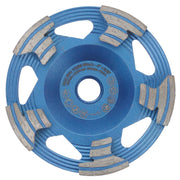
Grinding Cup Wheel Guide: Double Row, Turbo, or PCD — Which One Does What?
A diamond grinding cup wheel turns an ordinary angle grinder into a compact surface grinder — one of the most cost-effective upgrades on any concrete job. But the different cup wheel designs vary enormously in removal rate, surface finish, and tool life. Put the wrong type on the grinder and you either crawl across the slab or smear your coating removal into a sticky mess. Here is what each design actually does, and when to reach for it.
Double Row — the All-Rounder
A double-row cup wheel carries two concentric rings of diamond segments around the grinding face. The layout combines high stock removal with smooth, stable running — the two rows keep the wheel balanced on the surface, so it chatters less than single-row designs while still moving a lot of material.
Typical jobs where the double row shines:
- Leveling and flattening concrete surfaces
- Removing formwork ridges, fins, and casting seams
- Scuffing and opening up screed and cured slabs before the next trade
For general-purpose concrete grinding, the double row is the default first choice: fast enough for real removal, forgiving enough for everyday use.
Turbo — for Fine Finishes and Hard Material
Turbo cup wheels use angled, closely spaced segment teeth. The dense, slanted layout produces a noticeably finer scratch pattern with fewer chatter marks than a coarse segmented wheel — and it keeps cutting on hard, dense materials where softer-material wheels glaze over. That makes turbo the right pick in two situations:
- When the surface gets coated or skim-coated afterwards: A finer, more uniform grind means less telegraphing through thin coatings, self-levelers, and fillers.
- When you are grinding natural stone or granite alongside concrete — the turbo geometry handles hard stone far better than open segment layouts.
If your work leans toward brick, block, pavers, and stone, the PRODIAMANT Diamond Cup Wheel for Masonry & Stone pairs this kind of geometry with a bond matched to hard, dense material.
PCD — the Coating-Removal Specialist
PCD stands for polycrystalline diamond: instead of diamond grit embedded in a metal bond, PCD wheels carry solid diamond cutting tips that work more like planer knives than like an abrasive. They shave material off the surface rather than sanding it.
That distinction matters as soon as you hit anything soft, tough, or elastic. Standard diamond segments clog and smear on gummy materials; PCD tips slice them off cleanly. Typical PCD territory:
- Epoxy coatings and paint
- Carpet and tile adhesive (mastic)
- Waterproofing membranes and bitumen
- Thermoplastic and rubbery residues
PCD wheels are a distinct tool category with their own handling quirks — they are usually direction-dependent (marked rotation arrow) and are meant for the coating layer, not for grinding deep into bare concrete. Once the coating is off, switch back to a standard diamond cup wheel to profile the slab.
We cover the complete coating-removal workflow — matching the wheel to paint, epoxy, or mastic, plus the step-by-step process — in how to grind paint, glue, and epoxy off concrete.
Don't Forget Abrasive Materials
At the opposite end of the hardness scale sit abrasive, soft materials: green (fresh) concrete, sand-heavy screed, block, and other lime-sand masonry. These eat soft-bond wheels alive — the bond wears back far faster than the diamonds dull. For consistently abrasive material, use a cup wheel with a hard bond built for that duty; it will outlast a general-purpose wheel many times over. (The general rule: hard material needs a soft bond, soft abrasive material needs a hard bond.)
Grinding granite or dense natural stone specifically? Our guide to grinding granite with a diamond cup wheel goes deeper on bond choice and segment styles for hard stone.
Grind Dust-Free — It's the Rule, Not a Comfort Feature
Concrete dust contains crystalline silica, and grinding produces exactly the respirable fraction that damages lungs. Under OSHA's respirable crystalline silica standard (Table 1), surface grinding concrete requires a dust shroud on the grinder connected to a HEPA-filtered vacuum with adequate airflow for the wheel diameter. Add ANSI Z87.1 eye protection and, where the task requires it, a NIOSH-approved respirator. A shroud-and-vac setup also keeps the segments visible, the site clean, and cleanup time short — but the reason to run it is compliance and health, not convenience.
Full details on shroud types, required vacuum airflow, and respirator rules are in our dust shroud and OSHA silica requirements guide.
Quick Reference
| Type | Best for | Finish |
|---|---|---|
| Double row | General concrete grinding, leveling, formwork ridges, screed | Medium — fast removal, workmanlike finish |
| Turbo | Fine grinding before coatings; hard stone and granite | Fine — fewer chatter marks |
| PCD | Epoxy, paint, glue, mastic, bitumen removal | Strips coatings; not for finishing bare concrete |
| Hard-bond abrasive type | Green concrete, screed, block, abrasive masonry | Medium — built for wheel life on soft material |
Before you buy, check the mount: US angle grinders take cup wheels with either a 5/8"-11 threaded arbor or a 7/8" (22.23 mm) arbor with flange nut, and the wheel's rated RPM must meet or exceed your grinder's speed. And since the same grinder does double duty on most sites: for cutting rather than grinding, a general-purpose diamond blade like the Construction Raccoon or the hard-material Turbo Panther rounds out the kit.