Grinding Granite and Natural Stone: How to Pick the Right Diamond Cup Wheel
Grinding granite calls for specialized tooling. Not every diamond cup wheel that performs well on concrete will hold up on hard natural stone. Granite, quartzite, and similar dense stones punish the wrong wheel fast — the segments glaze over, removal rates drop, and you end up pressing harder for less result. This guide explains what actually makes a cup wheel work on granite, which segment style fits which job, and the selection mistakes that cost contractors the most money.
Why Granite Needs a Different Bond Than Concrete
Granite is a hard, dense igneous rock with a high quartz content. That combination is brutal on diamond tooling: the material barely abrades the metal bond that holds the diamond grit in place. A cup wheel designed for softer materials wears unevenly on granite — or worse, it glazes. Glazing means the exposed diamonds dull down and the bond doesn't wear back fast enough to release fresh, sharp grit. The wheel polishes instead of grinds, generates heat, and stops cutting.
The fix is a softer metal bond that erodes continuously under load, constantly exposing fresh diamond crystals. That keeps the wheel self-sharpening and the removal rate consistent from the first pass to the last.
Rule of thumb: the harder the material, the softer the bond needs to be. It sounds backwards, but it is the only way a diamond wheel keeps cutting on hard stone. A hard-bond wheel meant for abrasive materials like green concrete or block will simply stop working on granite.
Segment Style: Turbo, Full Rim, or Flat Grinding Disc
Bond hardness gets the wheel cutting; segment geometry decides how it cuts. The main options:
For a side-by-side of all cup wheel designs — double row, turbo, and PCD — see our grinding cup wheel guide.
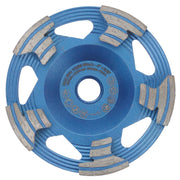
- Turbo segments: Angled, closely spaced teeth deliver aggressive stock removal. This is the go-to layout for first-pass grinding, knocking down high spots, and leveling uneven stone. Turbo segments also run noticeably smoother than widely spaced segments, so you get speed without excessive chatter.
- Full-rim (continuous) segments: A closed, continuous grinding face produces a calmer, more uniform finish. The better choice when you are working larger areas toward a homogeneous surface and scratch pattern matters more than raw speed.
- Flat grinding discs: For large, flat surfaces, a flat diamond grinding disc covers area more efficiently than a classic cup shape and leaves a more even scratch pattern. Worth considering when the job is square footage rather than spot work.
For professional stone work with a 4-1/2" or 5" angle grinder, the PRODIAMANT Diamond Cup Wheel for Masonry & Stone is built exactly for this use case: a bond matched to hard, dense material and a segment layout that keeps cutting on granite instead of glazing over.
Lightweight Cup Wheels for Overhead and All-Day Work
Weight on the grinder matters more than most spec sheets admit. Grinding overhead — undersides of stone lintels, ceilings, soffits — or putting in long shifts with a standard-weight cup wheel wears out your wrists and shoulders long before the wheel wears out. Lightweight cup wheel designs cut the rotating mass on the grinder without giving up grinding performance. If you regularly run longer sessions or work above shoulder height, the ergonomic difference is significant: less fatigue, better control, and a straighter grind at the end of the day.
Covering Large Flat Areas
Classic cup wheels concentrate their grinding face on a ring at the outer edge — great for aggressive spot removal, less ideal for big flat surfaces. On wide, even areas (stone slabs, large paver surfaces, flatwork), a flat grinding disc distributes contact across the face, covers more area per pass, and leaves a visibly more homogeneous finish. If the job is mostly open area, switching from a cup to a disc shape saves real time.
Common Selection Mistakes
- Wrong bond hardness: A hard bond on hard granite glazes over and loses performance. If your wheel stops cutting and starts sliding, the bond is almost always the culprit.
- Grit too coarse: Coarse segments leave visible scratch marks that take extra finishing steps to remove. Match grit to the finish the surface actually needs.
- Wrong arbor or thread: In the US, most cup wheels mount either on a 5/8"-11 threaded arbor (screws directly onto the grinder spindle) or a 7/8" (22.23 mm) arbor with a flange nut. Check what your grinder takes before ordering — an adapter is a workaround, not a solution.
- Too much pressure: Leaning on the grinder does not make a glazed wheel cut. It causes uneven segment wear and heat buildup, which shortens wheel life and can damage the stone. Let the diamonds do the work with moderate, steady pressure.
Dust Control and Safety
Granite has a high crystalline silica content, and grinding it dry produces respirable silica dust. Under OSHA's silica rule (Table 1), grinding masonry and stone requires engineering controls: run a dust shroud connected to a HEPA-filtered vacuum sized for the tool. Add ANSI Z87.1 rated eye protection, hearing protection, and a NIOSH-approved N95 or better respirator where required. Dust extraction is not a comfort feature on stone — it is a compliance and health requirement.
The exact OSHA Table 1 setup — shroud type, vacuum CFM, HEPA filtration — is covered in our guide to dust shrouds and silica requirements for angle grinders.
Frequently Asked Questions
Can I use a concrete cup wheel on granite?
Technically it will spin and remove some material, but expect significantly shorter life and weaker grinding performance. The bond is tuned for the wrong material — it won't wear back fast enough to expose fresh diamonds, and the wheel will glaze.
Working granite on patios, steps, and curbs? Our hardscaping diamond tool guide covers the full cutting-and-grinding kit for pavers and natural stone.
Which segment style for first-pass grinding?
Aggressive turbo segments are the standard choice for coarse initial grinding and knocking down high spots. Switch to a finer or full-rim wheel for finishing passes.
What should I check on the mount?
Make sure the wheel's 5/8"-11 thread or 7/8" arbor matches your angle grinder, and that the wheel's rated RPM meets or exceeds the grinder's no-load speed.
Is a lightweight cup wheel worth it?
For occasional spot grinding, a standard wheel is fine. For regular, longer sessions — especially overhead — the reduced weight pays off noticeably in ergonomics and control.
What if I need to cut granite, not just grind it?
Grinding and cutting are different tools. For clean, fast cuts in granite and other hard materials, a turbo-rim diamond blade like the PRODIAMANT Turbo Panther is the right companion to your cup wheel.