Dust Shroud for Angle Grinders: What OSHA Requires
Cut or grind concrete, screed, tile, or natural stone and you get a dense dust cloud within seconds. That dust contains respirable crystalline silica — particles fine enough to reach deep into the lungs, where they can cause silicosis, lung cancer, and other serious diseases. A dust shroud on your angle grinder, connected to a proper vacuum, is one of the most important pieces of safety equipment for anyone who does this work regularly. And in the United States, it is not just a good idea — on most jobsites, OSHA requires it.
What OSHA requires: the Respirable Crystalline Silica Standard
OSHA's Respirable Crystalline Silica standard for construction (29 CFR 1926.1153) sets a permissible exposure limit (PEL) of 50 micrograms of respirable crystalline silica per cubic meter of air, averaged over an 8-hour shift. Whenever workers cut, grind, or drill materials that contain silica — concrete, mortar, brick, block, tile, granite, and most other masonry products — the employer must keep exposure below that limit.
The standard gives contractors two ways to comply:
- Table 1: Follow the exact engineering controls, work practices, and respiratory protection that OSHA specifies for each task. Do this fully and correctly, and you do not need to perform your own air monitoring.
- Alternative exposure control methods: Measure actual exposure and prove your own controls keep workers below the PEL — a far more involved route that most crews avoid.
Table 1 for handheld grinders
For handheld grinders used for uses other than mortar removal (surface grinding, cutting with a cut-off wheel), Table 1 requires:
- A commercially available shroud that encloses the wheel, used according to the manufacturer's instructions
- A dust collector (vacuum) providing at least 25 CFM of airflow per inch of wheel diameter — for a 5" grinder, that means at least 125 CFM at the shroud
- A vacuum with a filter cleaning mechanism and 99% or greater filter efficiency — in practice, a HEPA-equipped dust extractor
- For work of more than 4 hours per shift indoors or in enclosed areas, a NIOSH-approved respirator with an assigned protection factor of at least 10 (such as a properly fitted N95 or half-mask elastomeric respirator)
For mortar removal (tuckpointing), Table 1 is stricter: shroud plus dust extractor plus a respirator with APF 10 for shifts up to 4 hours, and APF 25 beyond that.
In short: if you run an angle grinder dry on concrete or masonry on a covered jobsite, a dust shroud with a HEPA dust extractor is the baseline OSHA expects — not an optional upgrade.
Dust control is one of ten habits that keep grinder work safe — the rest are in our 10 angle grinder safety rules for cutting and grinding.
Why dust extraction matters beyond compliance
Even where OSHA does not reach — a homeowner cutting pavers in the backyard, for example — capturing dust at the source is the only method that reliably works. Ventilation and a basic dust mask alone cannot control the fine fraction of silica dust. The trades most affected are tile setters, concrete and screed finishers, stone masons, and remodeling and restoration crews.
Tuckpointing crews face the strictest Table 1 requirements of all — our guide to removing old mortar joints with an angle grinder shows the compliant setup for mortar raking.
What a good dust shroud delivers
- Dramatically less dust in the air you breathe
- A clear view of the cut or grind line instead of a dust cloud
- Far less cleanup after the job
- Less abrasive dust chewing up your grinder's motor and bearings — and less premature wear on the diamond tool itself
Which shroud fits which job?
The right shroud depends on whether you mostly cut or mostly grind, and on your wheel diameter.
For cutting
When you cut with a diamond blade, dust is generated in a concentrated stream along the kerf. A cutting shroud encloses the blade tightly and captures dust right at the cut. Most 5" (125 mm) cutting shrouds also accept 4-1/2" (115 mm) blades.
For grinding
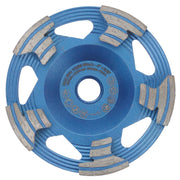
Surface grinding with a diamond cup wheel throws dust outward in every direction, so a grinding shroud covers the rotating cup wheel over its full face, usually with a brush skirt sealing against the floor or wall. Cutting and grinding shrouds are not interchangeable — the geometry is fundamentally different.
For switching between wheel sizes
If your crew runs both 4-1/2" (115 mm) and 5" (125 mm) tools, look for a shroud that is rated for both sizes so one shroud covers the whole grinder fleet.
Field tips for using a dust shroud
- Pair the shroud only with a dust extractor that meets the airflow requirement — 25 CFM per inch of wheel diameter — and has HEPA filtration with automatic or manual filter cleaning
- Check before every use that the shroud is clamped firmly on the grinder collar
- Do not use a dust shroud for wet cutting — slurry will clog the shroud and can damage the vacuum
- Wear a NIOSH-approved respirator in addition to the shroud where Table 1 calls for it, and any time you work indoors for extended periods
- Clean dust out of the shroud and hose after the job so airflow stays at full capacity
Common mistakes
- Using the wrong shroud type for the task — for example, a grinding shroud for cut-off work
- Hooking up extraction only "for the big cuts" instead of every cut — exposure adds up over the shift
- Running a shop vac with too little airflow or a clogged filter, which quietly defeats the whole system
Frequently asked questions
Is a dust shroud legally required?
On covered construction work, yes in practice: OSHA's silica standard (29 CFR 1926.1153) requires employers to control silica exposure, and Table 1 specifies a shroud plus dust extractor for handheld grinding and cutting of silica-containing materials. For private DIY work OSHA does not apply, but the health risk is exactly the same — capturing dust at the source is the recognized best practice either way.
Can I use a cutting shroud for grinding?
No. The designs differ fundamentally: cutting shrouds enclose the blade tightly along the kerf, while grinding shrouds cover the full face of a cup wheel. Using the wrong type leaves large amounts of dust uncaptured.
Do 5" shrouds fit 4-1/2" wheels?
Many 5" (125 mm) shrouds also accept 4-1/2" (115 mm) wheels — check the manufacturer's compatibility notes before buying.
What kind of vacuum do I need?
A dust extractor — not a household shop vac — with at least 25 CFM of airflow per inch of wheel diameter, a HEPA-grade filter (99%+ efficiency), and a filter cleaning mechanism. That is what Table 1 requires and what keeps suction alive through a full day of concrete dust.
Where the machine allows it, cutting wet is the other route to low dust — see wet vs. dry cutting with diamond blades for when each approach fits.