How to Grind Paint, Glue, and Epoxy Off Concrete: Tools, Steps, and Mistakes to Avoid
Removing old paint, adhesive residue, or a failed epoxy coating from a concrete slab is one of the most common jobs in concrete renovation — and one of the most frustrating to do with the wrong tool. Chemical strippers are slow and messy, scraping by hand is hopeless on large areas, and the wrong grinding wheel turns the coating into smeared gum instead of dust. Done right, grinding is fast, clean, and leaves the slab ready for whatever comes next. Here is how to match the tool to the coating and work through the job step by step.
Why Standard Diamond Wheels Fail on Coatings
Conventional diamond segments are built to grind hard, brittle mineral material — they abrade concrete into fine dust. Tough, elastic materials like epoxy resin, latex paint, or carpet adhesive behave completely differently under the wheel: instead of breaking into dust, they soften with friction heat, press into the segment surface, and coat the diamonds. The wheel loads up, starts smearing the coating around instead of removing it, and stops cutting. More pressure only makes the smearing worse.
PCD vs. Standard Diamond: Two Different Working Principles
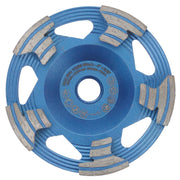
The answer to gummy coatings is a different cutting principle. PCD (polycrystalline diamond) tools don't grind at all in the abrasive sense — their solid diamond tips shave and mill the coating off the surface, much like planer knives. Because the material is sliced away in chips rather than rubbed into heat-softened paste, nothing sticks to the tool. That is what makes PCD the specialist for soft and elastic coatings, while classic bonded-diamond cup wheels remain the right tool for the mineral substrate underneath. Note that PCD wheels are usually direction-dependent — check the rotation arrow — and they are meant for the coating layer, not for profiling bare concrete.
For a complete comparison of double-row, turbo, and PCD cup wheels — including which finish each leaves — see our grinding cup wheel guide.
Matching the Tool to the Coating
| What's on the slab | Recommended tool | Why |
|---|---|---|
| Thin paint layers (concrete paint, exterior masonry paint) | Standard diamond grinding cup wheel, 5" (125 mm) | Thin, brittle paint films grind off together with a light pass over the surface; a dedicated coating tool isn't necessary. |
| Epoxy coatings | Cup wheel specified for coating removal | Epoxy's tough, rubbery consistency clogs general-purpose segments; a wheel tuned for coatings keeps cutting. |
| Mixed old layers, adhesives, mastic | PCD cup wheel with backing/support segments | PCD tips shave off glue and unknown layer stacks without loading up; the support segments limit bite depth so the tool doesn't dig into the slab. |
For the mineral grinding steps — thin paint, and re-profiling the concrete after the coating is off — a quality diamond cup wheel such as the PRODIAMANT Diamond Cup Wheel for Masonry & Stone on a standard angle grinder does the job. Check the mount before ordering: US grinders take either a 5/8"-11 threaded arbor or a 7/8" (22.23 mm) arbor with flange nut.
Step by Step: Grinding a Coating Off Concrete
- Rough-clean the surface. Sweep or vacuum off loose debris, sand, and grit. Loose particles under the wheel cause scoring and uneven wear.
- Test in an inconspicuous spot. Run the tool on a small area first. You'll immediately see whether the coating comes off cleanly as chips and dust or starts to smear — and can switch tools before committing to the whole floor.
- Work with even, moderate pressure. Keep the grinder moving in overlapping passes and let the tool cut at its own pace. Heavy leaning creates friction heat, which is exactly what makes paint and glue gum up.
- Run dust extraction the whole time. A dust shroud connected to a HEPA vacuum keeps the cutting zone visible and captures the silica-laden dust (see safety below).
- Inspect for residue. Check the finished area in raking light for remaining glossy patches or coating islands and re-grind them. Residue left behind will become a bonding failure under the new coating.
Common Mistakes
- Wrong tool for the coating: A general-purpose diamond wheel on epoxy or glue clogs within minutes. Match the tool to the layer, not to the slab.
- Too much pressure: Extra force generates friction heat, softens the coating, and accelerates smearing and segment wear. Moderate, steady pressure removes more per hour.
- Skipping dust extraction: Beyond the health and compliance problem, dust buildup hides the surface, insulates the wheel, and slows the work down.
Dust Control and Safety
Grinding concrete releases respirable crystalline silica. Under OSHA's silica standard (Table 1), surface grinding requires a shroud-equipped grinder connected to a HEPA-filtered vacuum with airflow matched to the wheel size. Wear ANSI Z87.1 rated eye protection, hearing protection, and a NIOSH-approved N95 or better respirator where required. Old coatings add their own hazard: paints in older buildings may contain lead — when in doubt, test before grinding and follow EPA RRP rules.
Everything OSHA Table 1 requires for surface grinding — shroud geometry, 25 CFM per wheel inch, HEPA filtration — is in our dust shroud and silica requirements guide.
The Goal: A Surface That's Ready for What Comes Next
The end result you are grinding toward is an open-pored, evenly roughened concrete surface with no glossy spots and no coating residue. That profile is exactly what new floor coatings, self-levelers, and tile thinset need to bond permanently. If the surface still shines anywhere, keep grinding — gloss means residue, and residue means adhesion failure later. Get it right once with the right wheel, and the new floor stays down.